
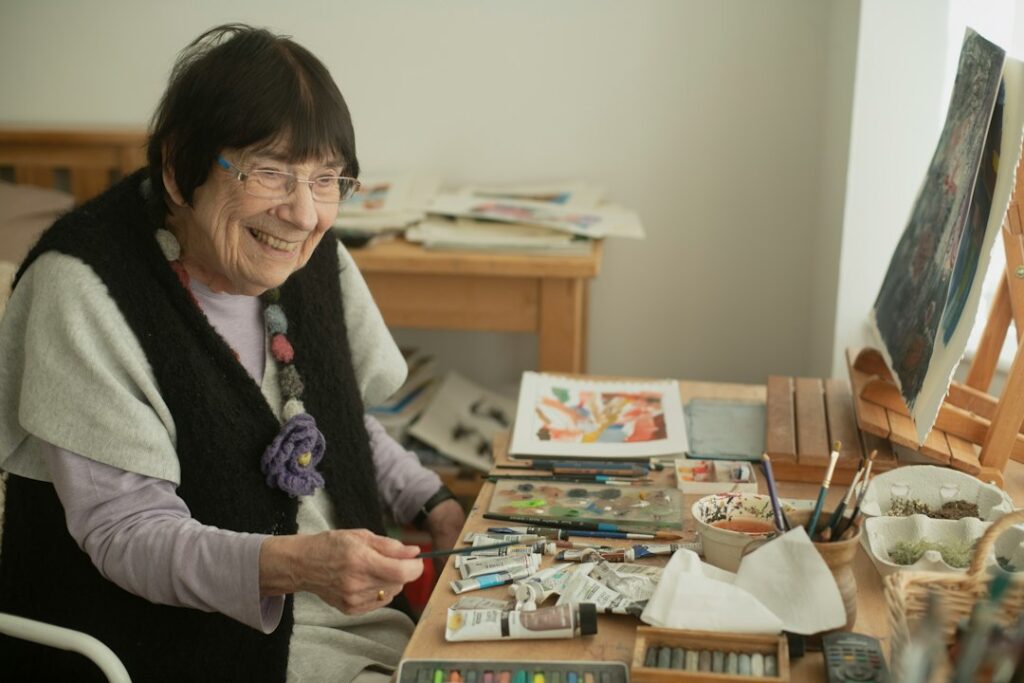
Creative activities can support emotional health, social connection, movement, memory, and personal identity in assisted living. They are not limited to drawing or painting; creativity can include music, storytelling, gardening, cooking, decorating, photography, sewing, puzzles, poetry, and everyday problem-solving.
Why does creativity matter for older adults?
Creative activity gives residents a way to express preferences, memories, humor, and feelings. It can also provide a sense of purpose, especially when familiar work, household responsibilities, or community roles have changed.
Participation may help residents:
- Maintain hand coordination through folding, painting, arranging, or assembling materials
- Practice attention and decision-making
- Recall meaningful experiences through music, photographs, recipes, or storytelling
- Build friendships through shared projects
- Reduce boredom and long unstructured periods
- Experience accomplishment without needing to compete
- Continue expressing personal style and cultural traditions
Creativity should not be treated as a test of artistic skill. The value is usually in the process, not in producing something that looks polished.
What types of creative activities work well in assisted living?
The most useful activities offer several ways to participate. A resident may create something independently, work with another person, or simply observe and comment.
Possible options include:
- Music: Listening sessions, sing-alongs, rhythm instruments, familiar songs, or discussions about favorite performers
- Visual arts: Watercolor, colored pencils, collage, seasonal decorations, simple printmaking, or large-format painting
- Writing and storytelling: Life stories, short poems, letters, family memories, or prompts about childhood traditions
- Textiles and crafts: Knitting, weaving, fabric collage, button art, paper folding, or sorting materials by color and texture
- Gardening: Indoor herb containers, flower arranging, seed starting, or caring for low-maintenance plants
- Food-based activities: Decorating cookies, assembling fruit cups, sharing family recipes, or discussing traditional meals
- Photography and memory projects: Reviewing personal photographs, making a picture book, or creating a display about favorite places and hobbies
- Movement with creativity: Gentle dance, chair exercises set to music, or hand motions that accompany familiar songs
Activities should be adapted to residents’ interests rather than selected only because they are easy to organize.
How can activities be adapted for residents with memory loss?
Residents with dementia or other cognitive changes can remain creative, but the activity may need fewer steps and less emphasis on following instructions. Familiar materials and repeated routines are often more comfortable than unfamiliar projects.
Helpful adjustments include:
- Presenting one or two choices instead of a large selection
- Demonstrating the first step rather than giving a long explanation
- Using larger, easier-to-hold tools
- Offering nonslip mats, built-up handles, or pre-cut materials
- Choosing familiar songs, colors, objects, and household activities
- Allowing residents to watch before deciding to participate
- Avoiding correction when the finished work looks different from the example
- Focusing conversation on the resident’s experience instead of testing memory
For example, arranging silk flowers may be more successful than completing a detailed craft with several written steps. A resident who no longer remembers a song title may still enjoy singing its melody.
What if a resident says, “I am not creative”?
Many people associate creativity with formal art skills and may reject an activity because they do not consider themselves artistic. A better approach is to connect creativity with something the resident already enjoys.
Someone who dislikes painting may enjoy:
- Organizing photographs
- Choosing music for a group
- Sharing family recipes
- Repairing or sorting objects
- Telling stories about former jobs
- Selecting colors for a room decoration
- Watching a demonstration and offering opinions
Questions such as “Which color feels right?” or “What song should come next?” can invite participation without labeling the activity as art. The goal is to provide meaningful choice, not to persuade someone to complete a project.
How can families support creativity during visits?
Family visits are often more engaging when they include a shared activity rather than conversation alone. A familiar project can make visits feel less pressured and may encourage memories to emerge naturally.
Families might bring:
- A small album of clearly labeled photographs
- A favorite magazine or nature book
- A simple craft with large, manageable pieces
- A recipe card for discussion
- Familiar music, if permitted by the residence
- Materials connected to a past hobby
- A seasonal object, such as a wreath, fabric sample, or artificial flower

It helps to avoid bringing too many materials at once. A small project that can be completed or revisited during several visits is often more comfortable than a complicated kit.
Residents may also appreciate being asked to teach something. Even if they cannot physically demonstrate every step, explaining how a recipe, craft, tool, or tradition was used can reinforce identity and respect.
How should assisted living staff make creative programs more inclusive?
A strong program allows residents with different abilities, backgrounds, and interests to participate without embarrassment. Staff can improve inclusion by offering multiple roles in the same activity.
During a group decorating project, for example, one resident might choose colors, another might arrange materials, another might cut paper, and another might provide encouragement or tell stories about similar decorations.
Inclusive planning should consider:
- Vision, hearing, strength, and dexterity
- Wheelchair access and table height
- Allergies, swallowing risks, and sensitivity to odors
- Cultural and religious preferences
- Previous experience with the activity
- Comfort with groups, noise, and public attention
- Whether the resident prefers independent or social participation
Residents should not be required to display their work, perform, or explain personal memories. Privacy and choice are part of respectful programming.
Are there safety concerns with creative activities?
Most activities can be made safer through preparation and supervision. Materials should match the resident’s abilities, and staff should follow the residence’s policies for tools, food, plants, adhesives, and small objects.
Extra care may be needed with:
- Scissors, needles, hot surfaces, and sharp tools
- Small pieces that may be swallowed
- Paints, glues, or cleaning products with strong odors
- Food allergies and dietary restrictions
- Plants that may be irritating or unsafe if touched or eaten
- Clutter that could interfere with walkers, wheelchairs, or exits
- Fatigue, frustration, or overstimulation
Safety does not require removing every challenge. It means adjusting the environment so residents can participate with an appropriate level of independence.
How can creativity fit the local rhythm of life?
Seasonal changes can provide useful themes without requiring residents to leave the building. During cold or wet periods, indoor activities such as music, quilting, photo projects, and window-safe plant care can add structure to the day. In warmer weather, residents may enjoy container gardening, outdoor sketching, flower arranging, or listening to music in a shaded area.
Local households may also bring traditions connected to family gatherings, church communities, school events, work histories, sports memories, or neighborhood celebrations. These personal connections are more meaningful than generic activities chosen without resident input.
The most effective creative programs are flexible. They make room for residents to contribute ideas, change direction, stop when tired, and return to a project later. A resident’s choice of color, song, story, arrangement, or subject can be just as meaningful as the finished result.
